
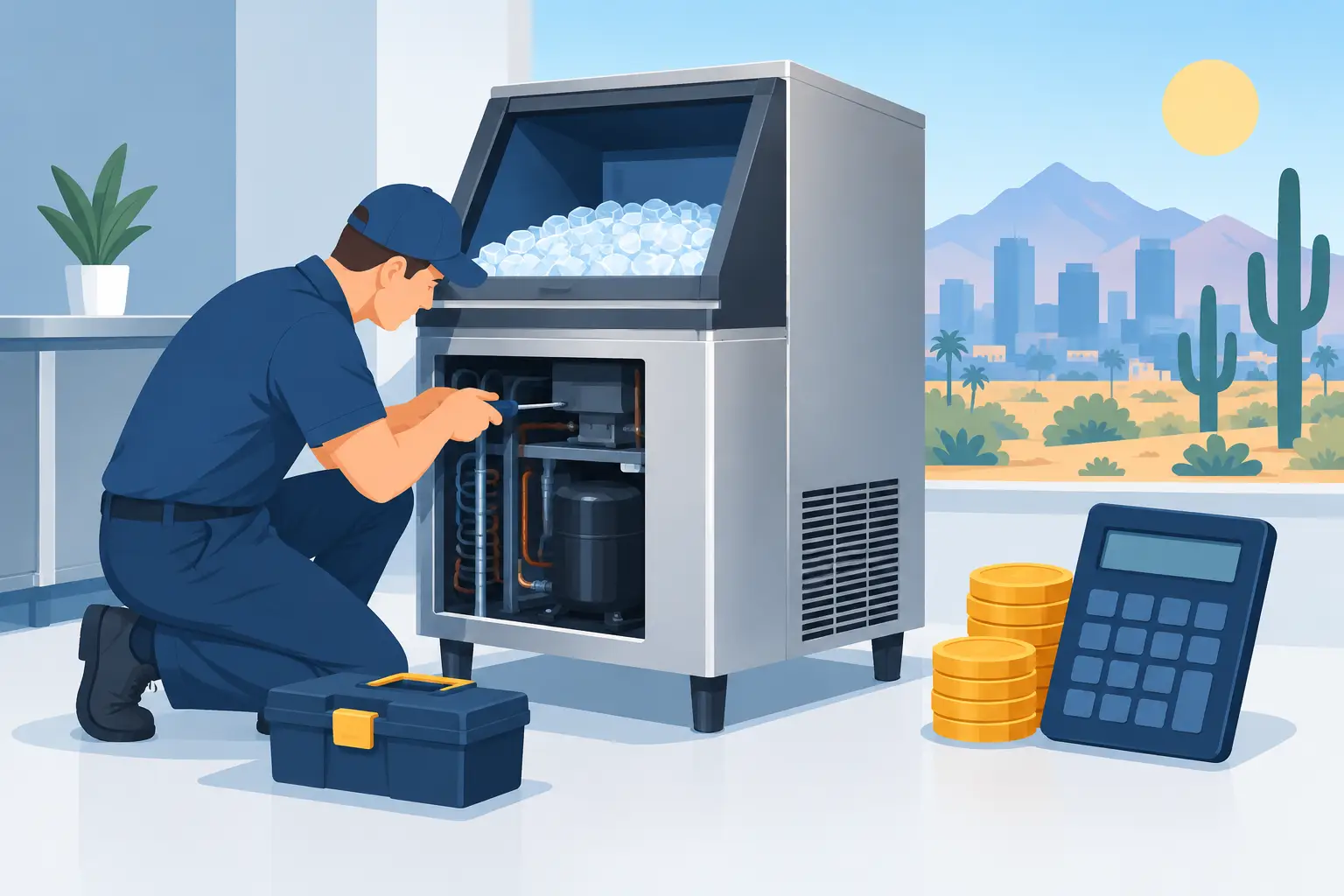
A full ice bin can feel like a small luxury until the machine suddenly stops making ice, leaks onto the floor, or produces cloudy cubes with an odd taste. Ice machine repair cost depends less on the symptom alone and more on what is causing it: a clogged water line, failed inlet valve, damaged control board, sealed-system problem, or heavy mineral buildup can all look similar at first.
For Phoenix homeowners, property managers, and foodservice operators, a professional diagnosis is the fastest way to avoid paying for the wrong repair. A technician can identify whether the problem is isolated to the ice maker or connected to the refrigerator, water supply, drain, or cooling system.
What Does Ice Machine Repair Cost?
Most ice machine repairs fall into a broad range of roughly $150 to $600, including parts and labor. A straightforward repair, such as clearing a restriction, replacing a sensor, or installing a common water-related component, may be toward the lower end. Repairs involving a pump, compressor, refrigeration system, major electronic control, or hard-to-source luxury-brand part can cost more.
That range is useful for planning, but it is not a quote. Built-in refrigerator ice makers, undercounter ice machines, and commercial units have different designs, access requirements, and parts costs. A Sub-Zero or Thermador built-in refrigerator, for example, may require more diagnostic time and brand-specific components than a standard freestanding refrigerator with an ice maker.
A service visit commonly includes diagnostic labor. If a repair is approved, some companies apply all or part of that diagnostic charge toward the completed work. Ask before scheduling how the diagnostic fee works, whether labor is covered by a repair warranty, and whether the estimate includes all anticipated parts.
What Has the Biggest Effect on Repair Pricing?
The part itself matters, but it is only one part of the bill. The exact model, the unit’s location, the time needed to reach the failed component, and the underlying cause all affect the final cost.
Type of ice machine
A refrigerator ice maker is typically smaller and less complex than a dedicated ice machine. It may use a fill tube, water inlet valve, thermostat or sensor, mold heater, motor, and ice dispenser components. A standalone undercounter or commercial machine has a more involved water and refrigeration system, often with pumps, reservoir components, evaporator plates, drain systems, and controls.
Commercial equipment can cost more to repair because downtime matters, access may be tighter, and the unit may need a more extensive cleaning and operational test before it goes back into service. On the other hand, a restaurant that addresses a small issue early may avoid a larger interruption during a busy shift.
The failed component
A frozen fill tube or worn water filter may be relatively inexpensive to address. A failed inlet valve, circulation pump, fan motor, ice maker assembly, or control board generally costs more because of the part price and installation time.
Sealed-system issues are in a different category. If a machine is not cooling correctly due to a compressor, refrigerant leak, or restriction, the repair requires specialized equipment and expertise. At that point, the technician should explain the repair cost alongside the unit’s age, condition, and expected remaining service life.
Mineral scale and water quality
Phoenix water can be hard on ice equipment. Mineral deposits can restrict water flow, affect sensors, block distribution components, and leave ice looking cloudy or misshapen. Scale does not always mean a major part has failed, but neglected buildup can create repeat problems and shorten the life of pumps and valves.
Cleaning is not a substitute for a needed repair. Still, when scale is caught early, a thorough cleaning and inspection can be less costly than waiting until water flow or freezing performance is affected.
Access and installation
A built-in refrigerator or a tightly installed undercounter unit may need to be carefully pulled out for diagnosis and repair. Water lines, drain connections, cabinetry, and ventilation clearance can all add labor time. This is especially relevant for premium installations from brands such as Sub-Zero, Viking, True, Bosch, Thermador, Gaggenau, Monogram, Café, and KitchenAid.
Common Ice Machine Problems and Typical Cost Ranges
The following ranges are general planning figures, not fixed pricing. Brand, model, parts availability, and the source of the failure can move the cost up or down.
A restricted water line, frozen fill tube, or minor water-supply issue may often fall around $150 to $300. If the water inlet valve needs replacement, a typical repair may be closer to $200 to $450. A refrigerator ice maker assembly replacement can range from about $250 to $600 or more, particularly on premium built-in models.
Repairs involving pumps, drain components, sensors, motors, or electronic controls often land between $250 and $700, depending on the machine. Major cooling-system work can exceed that range. A technician should not recommend an expensive repair without first confirming that the rest of the unit is in sound condition.
If the machine is making ice but the dispenser will not deliver it, the problem may be an auger motor, ice bin, dispenser door, switch, or frozen chute. If it is leaking, the cause could be a cracked line, drain blockage, overflowing reservoir, loose connection, or a failed valve. The visible symptom is only the starting point, which is why accurate diagnosis protects your budget.
Repair or Replace? Use the Whole Picture
Replacement is not automatically the better answer when a repair estimate is high. A quality built-in refrigerator or commercial ice machine can be worth repairing because replacement may involve cabinetry changes, installation work, plumbing adjustments, and a long lead time for a new unit.
Consider the unit’s age, overall reliability, repair history, energy use, and the cost of the proposed work. If the repair is a reasonable portion of replacement cost and addresses a specific failure, repair is often sensible. If the unit has repeated refrigeration failures, corrosion, multiple failing components, or unavailable parts, replacement may be the more practical long-term choice.
For a rental property, the decision may also come down to speed. A reliable repair that restores service quickly can be more valuable than waiting for a replacement, especially when a refrigerator’s ice maker is part of a tenant’s daily routine.
How to Avoid Paying for Preventable Problems
Regular care will not prevent every failure, but it can reduce the chance of water-flow and scale-related issues. Replace water filters on schedule when your appliance uses one, keep the machine clean according to the manufacturer’s directions, and do not ignore slow production, small cubes, unusual noise, or water around the unit.
Avoid forcing ice from a frozen bin or chipping at components with sharp tools. That can damage the ice maker mold, sensor, water line, or internal surfaces and turn a simple issue into a larger repair. If a refrigerator is not cooling properly, treat the ice failure as a warning sign rather than replacing only the ice maker.
When to Schedule Professional Service
Schedule service promptly if the machine leaks, trips power, stops cooling, produces no ice after a full cycle, makes unusually loud grinding sounds, or has visible ice buildup where it should not. A water leak can damage flooring and cabinetry, while poor cooling can point to a more serious refrigeration issue.
Hillside Appliance Services helps Greater Phoenix customers diagnose and repair residential refrigerator ice makers, premium built-in systems, and commercial ice equipment with clear explanations before work begins. The goal is not to sell an unnecessary repair. It is to identify the actual failure, explain the available options, and get your kitchen, rental unit, bar, or restaurant back to normal.
The best time to address an ice problem is usually before the bin is empty and the leak spreads. A timely diagnosis gives you a clearer choice between a targeted repair and replacement, while keeping a small inconvenience from becoming a disruptive one.