
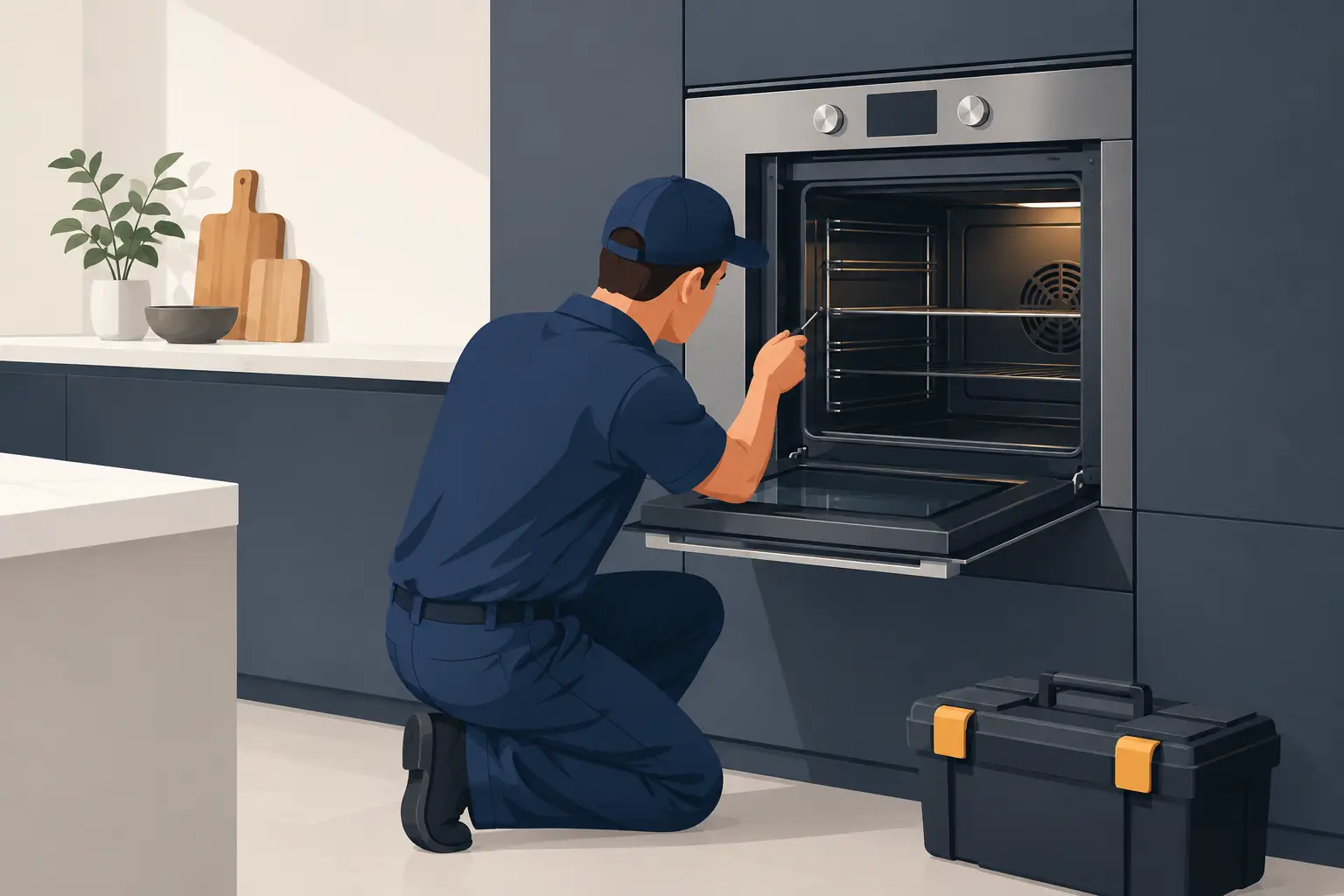
A Gaggenau oven is built to do more than heat food. It handles precise roasting, baking, broiling, and specialty cooking with the kind of control homeowners expect from a luxury kitchen. When it will not heat, displays an error code, trips a breaker, or cooks unevenly, Gaggenau oven repair should focus on an accurate diagnosis rather than a quick guess. Replacing the wrong part can be expensive, and electrical or gas-related issues should never be treated as a DIY experiment.
What Makes Gaggenau Oven Repair Different?
Gaggenau ovens use advanced controls, specialized heating systems, temperature sensors, cooling fans, and, in some models, steam or combination cooking components. The oven may look simple from the outside, but several systems must work together for it to preheat properly and hold the selected temperature.
That matters because the same symptom can have different causes. An oven that does not reach temperature may have a failed bake element, a weak relay on the control board, an inaccurate sensor, a wiring issue, or a door that is not sealing correctly. A professional diagnosis separates the cause from the symptom before a repair is recommended.
Luxury built-in ovens also require care during service. Accessing components may involve removing trim, securing a heavy unit, and working around cabinetry. An experienced technician protects the appliance and the surrounding kitchen while completing the repair.
Signs Your Oven Needs Professional Attention
Some oven problems are obvious, such as no heat at all. Others show up gradually through longer cook times, uneven browning, or a fan that continues running when it should not. Calling for service early can often prevent a small component failure from turning into a larger interruption to your kitchen routine.
The oven will not heat or preheat
If the display turns on but the oven stays cold, the issue could involve a heating element, igniter, thermostat, thermal fuse, control board, or power supply. Electric ovens typically need the correct 240-volt supply to heat, so a partially tripped breaker can leave lights and controls working while heating functions fail.
For gas models, a weak or failed igniter may prevent the burner from lighting. If you smell gas, turn the oven off, avoid operating switches or flames nearby, and seek qualified service promptly.
Food cooks unevenly or takes too long
A roast that browns on one side, cookies that bake inconsistently, or a dish that needs extra time can point to a temperature-control problem. The sensor may be reading incorrectly, a convection fan may not be circulating air properly, or one heating circuit may not be operating as it should.
It is tempting to compensate by increasing the temperature, but that can make results less predictable and may hide the real issue. A technician can test actual oven temperature and compare it with the selected setting.
Error codes or an unresponsive display
Modern Gaggenau ovens monitor their own functions. An error code may relate to a sensor, fan, latch, communication issue, or another electronic fault. Writing down the exact code and noting when it appears gives the technician a useful starting point.
A blank, flickering, or unresponsive display can also be caused by a power issue, control failure, or wiring problem. Repeatedly cycling power may clear a temporary glitch, but it is not a reliable fix for a recurring fault.
The oven door will not close, lock, or unlock
A door that will not close fully allows heat to escape and can affect cooking performance. Worn hinges, damaged gaskets, misalignment, or an obstructed latch can all be involved. If the door stays locked after a self-clean cycle, do not force it open. The latch assembly, control, or temperature-related safety function may need to be checked.
Unusual noises, odors, or breaker trips
A cooling fan can continue after cooking while the oven cools down, which is normal. Loud grinding, rattling, persistent buzzing, or a fan that never stops is not something to ignore. Likewise, a burning odor, visible sparking, smoke, or a breaker that trips during operation calls for immediate attention. Stop using the oven until the source is identified.
Safe Checks Before You Schedule Service
A few basic checks can help rule out simple issues without disassembling anything. These steps are safe for most homeowners, but they are not a substitute for electrical or gas repair.
- Confirm that the oven is not in a delayed-start, timer, Sabbath, demo, or specialty mode that changes normal operation.
- Check the household breaker panel. Reset a tripped breaker once, but do not keep resetting it if it trips again.
- Make sure the oven door closes completely and that no cookware, rack, or debris is interfering with the seal.
- Let the oven cool fully, then check for loose food debris around the door gasket and clean it gently.
- Record error codes, unusual sounds, when the issue occurs, and whether one cooking mode works while another does not.
Avoid removing panels, touching wiring, bypassing a door latch, or attempting to repair a gas ignition system yourself. Built-in ovens carry significant weight, and live electrical connections remain a risk even when the appliance appears to be off.
Common Gaggenau Oven Problems and Their Causes
Heating complaints are among the most common service calls. On an electric oven, a damaged bake or broil element may heat weakly or not at all. In other cases, the element is fine but the control is not sending power to it. A technician can test the component and circuit rather than relying on appearance alone.
Temperature problems often involve the oven sensor, calibration, airflow, or control system. Some small temperature variation is normal during a cooking cycle, especially as elements turn on and off to maintain heat. Consistent underheating, overheating, or major swings are different and should be evaluated.
Convection concerns can come from a failed fan motor, obstruction, damaged fan blade, or an issue with the fan circuit. Because convection performance affects airflow throughout the cavity, the result may be uneven cooking rather than a complete failure.
Self-cleaning cycles can expose an existing weakness in a latch, fuse, sensor, or control component because the oven reaches very high temperatures. This does not mean self-cleaning always causes a failure, but it can reveal a part that was already nearing the end of its service life. If your oven has had trouble after a self-clean cycle, service is preferable to forcing the door or repeatedly restarting the cycle.
Repair or Replace? The Practical Decision
A quality Gaggenau oven is often worth repairing, particularly when the issue is a heating element, igniter, sensor, fan, latch, or other serviceable component. Repair may be the sensible choice when the oven is otherwise performing well, integrates cleanly with the kitchen, and the expected repair cost is reasonable compared with replacement and installation.
The decision depends on the model, age, condition, parts availability, and the specific failure. An electronic control issue may cost more than a sensor replacement, while cosmetic damage or several major failures can change the calculation. A clear diagnosis gives you the information needed to make a practical choice without pressure.
For property managers, the equation also includes tenant disruption and turnaround time. For households that cook often, a nonworking wall oven can disrupt meals, holidays, and daily routines quickly. Prompt diagnosis helps everyone plan the next step with fewer surprises.
Choosing the Right Technician for a Luxury Oven
The best service call starts with a technician who understands built-in luxury appliances and takes time to diagnose the actual fault. Ask whether the company works on Gaggenau equipment, whether its technicians are trained to handle electrical and gas cooking appliances, and whether the diagnosis will be explained before repair work begins.
Hillside Appliance Services serves Greater Phoenix homeowners with experienced, customer-focused appliance repair for luxury and standard kitchen equipment. The goal is straightforward: identify the problem, repair it correctly when possible, and help restore a kitchen you can depend on.
If your oven is producing unreliable results, showing an error code, or creating a safety concern, stop working around the problem. A qualified inspection can turn an uncertain appliance issue into a clear repair plan and get your kitchen back to doing its job.